Romeo and Juliet Act 1 Study Guide
This study guide will help you understand the main events, characters, and themes of Act 1 of Shakespeare’s Romeo and Juliet. We’ll explore the setting, the feuding families, Romeo’s melancholy, the Capulet Ball, Romeo and Juliet’s first meeting, and the obstacles they face. This guide includes important quotes, literary devices, and study questions to help you delve deeper into the play.
Introduction
William Shakespeare’s timeless tragedy, Romeo and Juliet, tells the story of two young lovers from feuding families in Verona, Italy. Their passionate love defies the social and familial boundaries that seek to keep them apart, leading to a tragic end. Act 1 introduces us to the world of Verona, the feuding families, and the star-crossed lovers who are destined to meet. This act sets the stage for the play’s central conflict⁚ love versus hate, and the consequences of societal pressures. We are introduced to the core themes of love, fate, and the destructive nature of hatred.
Through the Chorus’s opening prologue, we are immediately drawn into the story’s tragic undercurrent. The audience is warned that the love between Romeo and Juliet will ultimately lead to their demise. This sets the tone for the play, foreshadowing the inevitable tragedy that awaits the lovers.
Act 1 also establishes the key characters and their relationships. We meet Romeo, the Montague, and Juliet, the Capulet, as well as their families and the people who surround them. Each character is introduced with their own personality and motivations, which play a crucial role in the unfolding events of the play.
Setting and Context
The play unfolds in the Italian city of Verona, a bustling center of commerce and culture during the Renaissance period. Verona’s vibrant atmosphere, with its lively streets and bustling marketplaces, provides a stark contrast to the intense and passionate love story that unfolds within its walls. The city’s rich history and cultural heritage add depth and context to the play, highlighting the societal norms and expectations that shape the characters’ lives.
The Renaissance era was a time of great societal upheaval and change, marked by a renewed interest in classical learning and a growing emphasis on humanism. This context informs the play’s exploration of themes such as love, fate, and the individual’s struggle against societal pressures. Verona becomes a stage for the clash between tradition and innovation, as Romeo and Juliet attempt to forge their own path despite the constraints of their families and society.
The setting of Verona also plays a crucial role in the play’s dramatic tension. The city’s narrow streets and hidden alleyways create a sense of secrecy and intrigue, adding to the suspense and danger that surrounds Romeo and Juliet’s forbidden love. The city’s bustling social life, with its grand balls and lively gatherings, provides opportunities for the characters to interact and for the play’s central conflict to unfold.
The Feuding Families
At the heart of Romeo and Juliet lies a bitter feud between two prominent families of Verona⁚ the Montagues and the Capulets. This long-standing animosity, passed down through generations, has poisoned the city’s atmosphere, creating a climate of mistrust and violence. The families’ hatred for each other is so deeply ingrained that even the slightest provocation can spark a brawl, turning the streets of Verona into battlegrounds.
The feud’s origins are shrouded in mystery, lost in the mists of time. However, its enduring presence casts a long shadow over the play, shaping the characters’ destinies and driving the tragic events that unfold. The families’ animosity creates a hostile environment for Romeo and Juliet, making their love an act of defiance against the established order.
The feud’s destructive nature is evident from the very beginning of the play, as the servants of both families engage in a violent brawl. This clash, fueled by their masters’ hatred, serves as a stark reminder of the deep-seated animosity that permeates the city’s social fabric. The feud’s tragic consequences are ultimately revealed in the play’s final scene, where Romeo and Juliet’s love story ends in a heartbreaking and violent climax.
Romeo’s Melancholy
At the start of the play, Romeo is consumed by a deep and brooding melancholy. He is in love with Rosaline, but she remains indifferent to his affections. This unrequited love weighs heavily on his spirit, leading him to withdraw from social gatherings and indulge in introspective musings. Romeo’s friends, Benvolio and Mercutio, attempt to cheer him up by urging him to seek out other women, but their efforts prove futile.
Romeo’s melancholy is a prominent theme in Act 1, highlighting his emotional turmoil and the complexities of love. It sets the stage for his later encounter with Juliet, where his initial despondency is quickly replaced by a passionate and transformative love. Romeo’s initial melancholy serves as a foil to the intense passion he experiences when he meets Juliet, showcasing the dramatic shift in his emotional state.
Shakespeare’s portrayal of Romeo’s melancholy is both poignant and relatable, capturing the universal experience of unrequited love and its profound impact on the human heart. The play reveals that love can be a source of both joy and sorrow, and that even the deepest despair can be overcome by the transformative power of genuine connection.

The Capulet Ball
The Capulet Ball is a pivotal event in Act 1 of Romeo and Juliet. It is a grand and festive gathering hosted by Lord and Lady Capulet, intended to celebrate their daughter Juliet’s birthday and to provide an opportunity for her to meet potential suitors. The ball is a significant moment in the play for several reasons. It marks the first encounter between Romeo and Juliet, setting in motion the course of their love affair.
The ball is a celebration of wealth and social status, reflecting the opulent lifestyle of the Capulet family. However, the festivities are overshadowed by the simmering feud between the Capulets and Montagues, creating a tense atmosphere. The presence of both families at the same event underscores the inherent danger of their conflict and foreshadows the tragic consequences that will ensue.
The Capulet Ball is a microcosm of the play’s central themes of love, fate, and societal constraints. It is a night of both joy and sorrow, where the characters’ destinies are intertwined in a complex web of passion, prejudice, and ultimately, tragedy.
Romeo and Juliet’s First Meeting
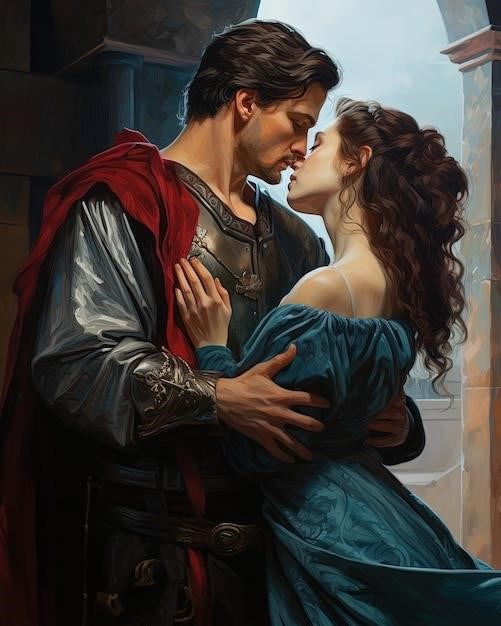
The Capulet Ball serves as the stage for Romeo and Juliet’s first encounter. It is a moment brimming with both excitement and foreboding, as the two young lovers, unaware of their families’ bitter feud, find themselves drawn to each other. The meeting is marked by an immediate and intense attraction, a love at first sight that transcends the animosity that divides their families. Romeo, captivated by Juliet’s beauty and grace, declares her to be “a rich jewel in an Ethiop’s ear.” Juliet, in turn, is smitten with Romeo’s charm and wit, finding him “a handsome, courteous, and a gentle youth.”
Their initial meeting is a whirlwind of passion and romance. Romeo, despite his recent heartbreak over Rosaline, finds himself completely consumed by Juliet’s presence. Juliet, although initially hesitant due to the societal expectations surrounding her, is swept up in the intensity of Romeo’s affections. Their first conversation is a dance of words, filled with metaphors and poetic imagery, as they express their growing love for each other. Theirs is a connection that defies logic and social conventions, a love that transcends the limitations of their families and the world around them. Their first meeting, however, also foreshadows the challenges and obstacles they will face in their pursuit of love.
Love at First Sight
The concept of love at first sight is a central theme in Act 1 of Romeo and Juliet, and it is most vividly portrayed in the meeting of Romeo and Juliet at the Capulet Ball. Shakespeare masterfully depicts the immediate and intense connection that arises between the two young lovers, a connection that defies logic and social conventions. Romeo, immediately struck by Juliet’s beauty, declares her to be “a rich jewel in an Ethiop’s ear,” highlighting her beauty and grace. Juliet, in turn, is captivated by Romeo’s charm and wit, finding him “a handsome, courteous, and a gentle youth.” Their encounter is a whirlwind of passion and romance, fueled by an undeniable attraction that transcends the animosity that divides their families.
The play challenges the audience to consider whether this instant, passionate love is genuine or merely an infatuation. While some might dismiss their connection as a fleeting fancy, Romeo and Juliet’s declarations of love are heartfelt and sincere. They express their feelings through poetic language and imagery, revealing the depth of their emotions. Their love, however, is also a dangerous and reckless pursuit, a force that threatens to shatter the fragile peace of Verona. The audience is left to ponder whether this love at first sight is a force for good or a catalyst for tragedy.
Obstacles to Their Love
From the very beginning, Romeo and Juliet’s love is challenged by a multitude of obstacles. The most immediate and insurmountable barrier is the age-old feud between their families, the Montagues and the Capulets. This bitter rivalry has poisoned the atmosphere of Verona, creating a climate of mistrust and violence. Romeo and Juliet are forbidden to love each other, their families’ hatred making their romance a dangerous and forbidden act.
Further complicating their situation is the fact that Juliet is being pressured to marry Paris, a young nobleman favored by her family. The prospect of an arranged marriage is a stark contrast to the passionate, spontaneous love that Romeo and Juliet share. Their desire to be together is further hampered by the secrecy they must maintain, forced to conceal their love from their families and the world. Their clandestine meetings and stolen moments only intensify the drama and heighten the stakes of their forbidden romance.
The weight of societal expectations, family pressures, and the looming threat of violence all conspire to make Romeo and Juliet’s love a perilous and fragile endeavor. Act 1 sets the stage for a tragic love story, where the lovers are pitted against seemingly insurmountable odds.
Themes Introduced in Act 1
Act 1 of Romeo and Juliet lays the groundwork for several central themes that will be explored throughout the play. The most prominent is the destructive power of hatred and the consequences of family feuds. The ongoing conflict between the Montagues and Capulets fuels violence and creates a climate of fear and distrust. The play demonstrates how these ancient grievances can poison relationships, even between those who are not directly involved in the feud.
Love and its complexities are also introduced early on. Romeo’s initial infatuation with Rosaline showcases the fickle nature of youthful love, while his sudden and passionate love for Juliet presents a powerful and transformative force. The play explores the intoxicating nature of love at first sight and the potential for love to transcend social barriers.
Fate and its role in human destiny are also introduced through the Chorus’s prologue. The play suggests that Romeo and Juliet are “star-cross’d lovers,” implying that their love is destined to be tragic. The concept of fate serves as a constant undercurrent throughout the play, leaving the audience to ponder the extent to which human actions are predetermined.
Key Characters
Act 1 introduces a cast of characters who play pivotal roles in the unfolding drama. Romeo Montague, the play’s protagonist, is a young man consumed by love and prone to melancholy. He is initially infatuated with Rosaline but quickly falls deeply in love with Juliet. Juliet Capulet, the play’s heroine, is a young woman who is both headstrong and innocent. She is caught between her family’s expectations and her own desires, leading to a tragic conflict.
The feuding families are represented by Lord Montague and Lady Montague, Romeo’s parents, and Lord Capulet and Lady Capulet, Juliet’s parents. The play’s central conflict stems from their long-standing rivalry. Other significant characters include Benvolio, Romeo’s loyal friend, and Mercutio, a witty and flamboyant member of Romeo’s circle. These characters, along with Nurse, Juliet’s confidante, and Tybalt, Juliet’s hot-tempered cousin, contribute to the complex web of relationships and conflicts that drive the play’s narrative.
Literary Devices
Shakespeare masterfully employs a range of literary devices to enhance the play’s themes and create a powerful dramatic effect. One prominent device is foreshadowing, where hints of future events are subtly woven into the dialogue and action. The Prologue, for instance, foreshadows the tragic fate of Romeo and Juliet, setting the stage for the inevitable downfall. Imagery, the use of vivid language to create mental pictures, is another key device. Shakespeare’s descriptions of love, death, and violence appeal to the senses and create a heightened emotional impact. The iconic balcony scene, for example, features rich imagery of moonlight, roses, and stars, evoking a sense of romance and beauty.
Symbolism plays a significant role in conveying meaning. The feud between the Montagues and Capulets, for instance, symbolizes the destructive nature of hatred and prejudice. Romeo’s initial infatuation with Rosaline, who represents unattainable love, contrasts with his passionate love for Juliet, who embodies true love. Dramatic irony adds a layer of complexity to the narrative. The audience is often aware of information that the characters are not, creating moments of suspense and anticipation. For example, the audience knows that Romeo and Juliet are in love, but their families remain oblivious, adding to the tragic tension.
Important Quotes
Act 1 of Romeo and Juliet is rich in memorable quotes that encapsulate the play’s themes and character motivations. One of the most famous lines, from the Prologue, is “From forth the fatal loins of these two foes / A pair of star-cross’d lovers take their life.” This sets the tragic tone and introduces the concept of fate, which plays a pivotal role in the story. Another significant quote, uttered by Romeo in Act 1, Scene 1, is “Why, then, O brawling love! O loving hate! / O anything, of nothing first create! / O heavy lightness! serious vanity! / Misshapen chaos of well-seeming forms! / Feather of lead, bright smoke, cold fire, sick health!” This soliloquy reveals Romeo’s internal conflict and his confusion about love, highlighting his melancholic state.
The quote “Did my heart love till now? for I ne’er saw true beauty till this night” from Romeo’s first encounter with Juliet in Act 1, Scene 5, expresses the intensity of his love at first sight. Juliet’s famous words, “My only love sprung from my only hate! / Too early seen unknown, and known too late!” in the same scene capture the irony and tragedy of their love. These quotes, along with many others, reveal the complexity of the characters’ emotions, the power of love, and the inevitability of their fate.
Study Questions
To delve deeper into the themes and nuances of Act 1 of Romeo and Juliet, consider these study questions⁚
- How does Shakespeare introduce the feud between the Montagues and Capulets in Act 1? What are the historical and social implications of this feud?
- Analyze Romeo’s character in Act 1. What are his motivations? How does his melancholy affect his actions?
- What is the significance of the Capulet Ball in Act 1? How does this event contribute to the development of the plot?
- Examine Romeo and Juliet’s first meeting. What are the key elements of their connection? How does Shakespeare use language and imagery to depict their love at first sight?
- What obstacles to Romeo and Juliet’s love are introduced in Act 1? How do these obstacles contribute to the play’s tragic theme?
- What themes are introduced in Act 1? How do these themes foreshadow the events that will unfold in the play?
- Analyze the use of literary devices, such as imagery, metaphor, and foreshadowing, in Act 1. How do these devices enhance the play’s meaning and impact?
By exploring these questions, you can gain a deeper understanding of the play’s complex characters, themes, and plot development, enhancing your appreciation of Shakespeare’s masterpiece.